Welcome To Esperanza Elementary Blog

I want to give you a special welcome to our Esperanza Elementary blog as we take our journey to found the school of our dreams. I invite you to visit us often and offer any ideas, thoughts, suggestions, questions, comments, etc. you might have.

Wednesday, November 7, 2012

Hablemos el Mismo Idioma/ We Speak the Same Language

These are the lyrics to a song, Hablemos el mismo idioma, by Gloria Estefan.  Although they are directed to Latinos, I feel there is a message for all of us.  I learned about the song when reading the book Diary of a Bilingual School.  The students were learning the lyrics. 


En la vida hay tantos senderos por caminar
qué ironia que al fin nos llevan al mismo lugar
pesar de las diferencias que solemos buscar
respiramos el mismo aire, despertamos al mismo sol
nos alumbra la misma luna, necesitamos sentir amor
hay tanto tiempo que hemos perdido por discutir

por diferencias que entre nosotros no deben existir
las costumbres, raices y herencias que me hacen quien soy
son coloros de un arcoiris, acordes de un mismo son
las palabras se hacen fronteras, cuando no nacen del corazón
hablemos el mismo idioma y así las cosas irán mejor

(coro)
hablemos el mismo idioma, que hay tantas
cosas porque luchar
hablemos el mismo idioma, que solo unidos se lograrán
hablemos el mismo idioma, que nunca es tarde para empezar
hablemos el mismo idioma, bajo la bandera de libertad

si lo pensamos nosotros tenemos tanto en común
y no conviene que el mundo nos oiga
con una sóla voz
es importante seguir adelante con fuerza
y con fé
forgemos nuevos caminos, en la unión hay
un gran poder
orgullosos de ser latinos no importa
de donde, todo podemos vencer

(coro)
hablemos el mismo idioma, que hay tantas
cosas porque luchar
hablemos el mismo idioma, que solo unido se logrará
hablemos el mismo idioma, que nunca es tarde para empezar
hablemos el mismo idioma, bajo la bandera de libertad

hablemos el mismo idioma dame la mano
mi hermano
(ad lib) no importa de donde seas todos
somos hermanos tú ves
que no existan las diferencias entre nosotros hispanos
en esta vida hay que trabajar para lograr lo que queremos, latinos
las palabras se hacen fronteras cuando no se
hablan del corazón si tú ves
no importa raza ni religion, somos hermanos
en el corazón pero que fuerza tenemos
los latinos si nos mantenemos unidos

(Translation:

In life there are so many paths that we can choose to walk
how ironic that they all lead to the same place
in spite of all the differences that we tend
to look for in each other
we all breathe the same air and wake up to the same sun
the same moon shines down on all of us
and we all have the need to feel love
we've already wasted so much time arguing about differences
that should not exist between us
the customs, races and inheritances

that make me who i am
are like the colors in a rainbow, different chords in one song
and words can become barriers when they don't come from the heart
let's speak the same language
and that way things will go so much better
let's speak the same language
there are so many things worth fighting for
let's speak the same language
only united can we achieve the things we want let's speak the same language
it's never too late to begin let's speak the same language
under the flag of freedom

if we think about it, we have so many things in common
and it's better if the world hears us as one voice
it's important to always look forward with
strength and with faith
let's forge some new paths with strength in our unity
proud of being latin, it doesn't matter from "where"
we can overcome anything (repeat chorus)
let's speak the same language
give me your hand, my brother
it doesn't matter where you're from, we're all brothers, you see

let's speak the same language
give me your hand, my brother
let there be no differences between us, hispanics
let's speak the same language
give me your hand, my brother
in this life we have to work for what we want to achieve
let's speak the same language
give me your hand, my brother
words become barriers when they're not spoken from the heart
let's speak the same language
give me your hand, my brother

let's speak the same language
give me your hand, my brother
it doesn't matter what race or religion we are
we're all brothers from the heart
let's speak the same language
give me your hand, my brother
if, as latins we stand united, we can be very strong
let's speak the same language
give me your hand, my brother

Monday, November 5, 2012

Deviation


I read a quote this morning that supports this article by Kevin Eikenberry:  Only dead fish swim with the stream (Anonymous). 

Vote for Deviation
by Kevin Eikenberry on November 2, 2012
 
 
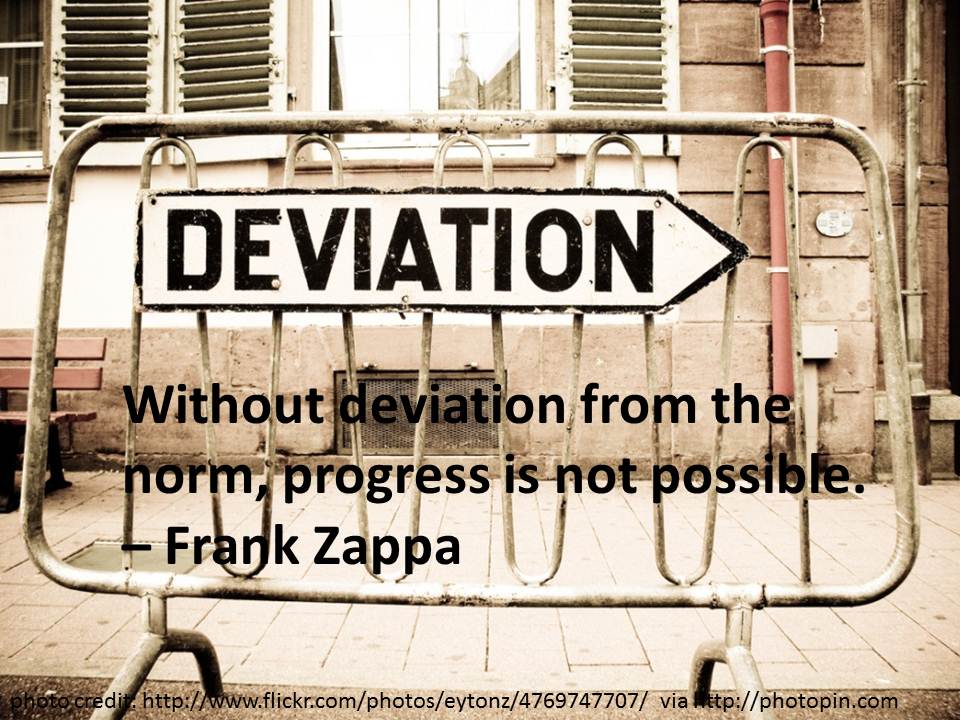
Frank Zappa deviation quotation
I love thinking (and quotations) that come from unexpected sources. Sometimes the power of the idea seems stronger or more profound when we know the source.
Frank Zappa certainly meets this criteria. Zappa was a free thinker, talented musician and much more (I encourage you to read a bit of his Wikipedia entry if you don’t know much about this complex rock star).
Add to the mix that today’s quotation takes a word most people probably have negative thoughts attached to and puts it in a new light. All those elements lead to a very useful and intriguing thought (and I hope, post).
“Without deviation from the norm, progress is not possible.”
–Frank Zappa, singer-songwriter
Questions to Ponder
- When was the last time I looked at deviation as a good thing?
- How can I put the word deviation in a better light in my life?
- What progress am I missing by dismissing things “different from the norm”?
Action Steps
1. Look for the abnormal and unusual today.
2. Look at mistakes, not just as something to be fixed, but something to be learned from.
3. Look for ways to promote deviation from the norm, as a strategy for innovation.
quotation from Frank Zappa

My Thoughts
In the workplace, deviation often refers to the statistical idea of a result different from what is intended. Starting with the work of Joseph Juran and W. Edwards Deming, organizations have tried to manage and reduce variation to produce higher quality outputs. All of this is the precursor to the Lean and Six Sigma processes widely used today. In these worlds deviation is to be reduced and eliminated.
Look at the dictionary definitions of this word and you will find many of them skewing to negative ideas (the word “abnormal” is used – rarely considered a good thing). And I’m sure the idea of a social deviant or deviant behavior comes to your mind when you think about this word.
And yet, Zappa is right.
If nothing ever changes, nothing will change – and no progress will even been seen as possible.
Are you stifling the out of the box thoughts? Is your team hiding the deviations (read mistakes) in their work processes? Now that you have read these thoughts, I challenge you to read the quotation again, ask yourself the questions and take the action described above.

Sunday, November 4, 2012

History Fascination

Civil War Still Relevant In Our Lives Today
by James McPherson           

November 29, 2011-- BYU Forum


From 1861 to 1865, more than 2 percent of the American population was killed in the Civil War. Although that was 150 years ago, Tuesday’s forum speaker told students why the Civil War has relevance and captures our interest, even today.
James M. McPherson, professor emeritus of American history at Princeton University, titled his remarks, “Why the Civil War Still Matters Today.”
“A bookstore owner in Falls Church, Va., said, also in the 1980s, for the last two years Civil War books have been flying out of here,” McPherson said. “It’s not just the buffs who buy, it’s the general public, from high school kids to retired people.”
Sarah Strobel
Princeton University professor and Civil War historian James M. McPherson addresses BYU students at Tuesday's forum about why the Civil War still matters.
McPherson received the 1989 Pulitzer Prize in history for his book, “Battle Cry of Freedom: The Civil War Era.” He also received the Pritzker Prize for Lifetime Achievement in Military Writing in 2007.

McPherson discussed the history and significance of the Civil War today and in the Civil War era. He also recounted several statistical examples to explain why people are still fascinated with the Civil War.
More than 620,000 soldiers and unnumbered civilians were killed during the war, McPherson said. To relate that to today’s population, if 2 percent of the population were to die that would equal about 6 million individuals.
Individuals are continually interested in the Civil War, especially with the 150th anniversary of the Civil War approaching.
“Then there are the larger-than-life near mythical individuals on both sides whose lives and careers continue to fascinate us today — Abraham Lincoln, Robert E. Lee, Clara Barton and on and on,” McPherson said. “There’s a kind of romance as well as tragedy about those people and their times that is hard to resist.”
McPherson also discussed the importance of the civil rights movement and amendments to the Constitution.
“The Civil War accomplished a historic shift in American values in the direction of positive liberty,” McPherson said. “The change from all those ‘shall nots’ in the first 10 amendments to the Constitution to the phrase ‘Congress shall have the power’ is indicative of that shift.”
McPherson has authored 16 books and edited others as well. He focuses his writing mostly on the era of the American Civil War and Reconstruction period.

Saturday, November 3, 2012

What I Wear to School

Felt this was worth thinking about. 

Education Week
 
Published Online: October 30, 2012
Published in Print: October 31, 2012, as About the Necktie
Commentary

About the Necktie

Maybe this is a silly thing to think and worry about as an educator, but it is something I wrestle with every morning. I never really paid much attention to it in my other jobs, but I now stare at myself in the mirror each morning with this question: What do I wear to school?
It sounds like something a 5-year-old would ask (I don't believe my tone is quite as whiny), but I really do fret about this every day. Even now, working in a university setting, I spend a good deal of time deciding on my appearance before leaving the house each morning.
This indecision dates back to my first year of teaching in an elementary school a few years ago and continues to this day in my work at a university. My wife and I were fresh out of the Peace Corps, and I was pretty laid-back about the clothes I wore to school every day. A typical outfit would involve khakis and some sort of untucked polo shirt. Not nearly as dressed-down as I was for my volunteer experience in the Philippines, but not the best I could do. I think subconsciously I was trying to go for the I-just-returned-from-Peace-Corps-and-don't-want-(or-know-how)-to-dress-professional look. Judging from pictures of that year, I hit that look spot on. The following year was more of the same, with a couple of haircuts thrown in. Then something shifted. It started with a simple bet I made with myself: Could I wear a tie every day to school for a month?
I teach in rural New Mexico. Unfortunately, the state ranks toward the bottom of the nation in personal income and toward the top in poor health habits and alcohol use. In this high-poverty area, even a teacher like me wearing a $6.99 discount-store tie is a pretty unusual sight. I definitely stood out. By the end of the first week, my 5th graders were asking me why I was so dressy, and one teacher scoffed, "Isn't that a bit much for here?"
"Was I supposed to conform to the prevailing culture and dress more like my co-workers?"
For better or worse, regardless of the comments, I stuck to my bet for a month and ended up really liking wearing a tie to school. I felt more professional. I felt more important. I felt like my students felt like they were more important. I decided to continue my bet for the entire year.
My male principal occasionally tossed on a bolo, which fit the school's style quite well. Seeing this made me think a lot about what I was doing and gave me incentive to stick with it. Yet the comment from that one teacher ate at me. What did families and the other teachers think of me? Was it too much? Was I supposed to conform to the prevailing culture and dress more like my co-workers, even if sometimes I felt like they were too dressed-down for our profession? I began to focus more on how other people dressed and how I looked in contrast.
Then in the middle of the school year, my students and I had a surprise that convinced me to go all double-Windsor every time I entered a classroom.
My 5th graders wrote letters to provoke meaningful change in the world. Many students decided to write to President Barack Obama asking him to take seriously the problems of bullying in schools and alcohol abuse among preteens—both of which are major problems in our area. Though I was a Negative Nelly and told them they would have a better chance of getting a response from a local official, the White House responded. We received a letter from Washington, and I was stunned to receive a voice mail from the White House as well, informing me that if the president were in our area, he would love to stop by and see us.
This got me thinking. What if the president really did decide to come to our school? How would that change the way people dressed? I believe everyone would be dressed to the nines because, well, that is what people usually do when a world leader visits. I know I would. I would be sure to wear a tie if the president were visiting.
If I wore a tie for an important person like the president of the United States but not for my students, what kind of message would that send? If I did not wear a tie, did that mean they were unimportant? I don't know if my students would ever reach that conclusion, but I felt like it was implied somehow. We dress up for important people and events. We dress up for presidents. My students are important. Every day of school is important, as important as if the president were visiting.
While I am not proselytizing that every staff member in a school building dress up, I do feel that students need to know they matter. So I wear a tie. I shine my shoes. I get haircuts. I try to reflect their value by what I wear, how I speak, and how I behave. When I enter a classroom, I think about how I look because I want my students to know they are important, as important as a president.

Friday, November 2, 2012

Celebrating the Day of the Dead

This is a great article!
 
Bread of life: Celebrating the Day of the Dead

Food • Egg-rich loaves of bread are part of the Mexican celebration of departed loved ones.


image
Steve Griffin | The Salt Lake Tribune A skeleton hangs from the ceiling during the 2011 Utah Cultural Celebration Center's Day of the Dead exhibit.

This week at Mexican bakeries across the state, employees are extra busy making and baking “bread of the dead.”

The name may sound somber and eerie, but these egg-rich loaves are one of several joyous symbols of the Día de los Muertos holiday, better known as “Day of the Dead.”

During this two-day celebration, which takes place Nov. 1 and 2, the souls of departed loved ones are said to come back to the world, and their families celebrate with food, music and dancing. The celebration dates back to ancient Aztec traditions and ties in with the All Souls Day and All Saints Day in the Roman Catholic Church.

“It’s not scary or ghoulish like Halloween,” explained Marla Youssef. “We are happy and joyous about the life they had and hope that they will continue to be happy wherever they are.”

Youssef’s family has organized a Day of the Dead event at the Utah Cultural Celebration Center in West Valley City for nine years. (See info box.) This free public event includes a traditional altar display, as well as folk art, food, music and family activities.

“Everything Mexicans do is artistic: the way we speak, the way we dance, the way we display and serve food,” Youssef said.

But for Day of the Dead, relatives go the extra mile for those who have passed. “If you know you’re making something for your father or grandfather, you’ll spend a little more time to make sure it’s perfect,” she said.

To remember their loved ones, families create altars or ofrendas with food and objects that represent the deceased. Tradition says the more elaborate the altar, the more likely the person’s spirit will return to be with family and friends.

The most anticipated altar item is pan de los muertos, a simple yeast bread made with flour, eggs, milk and butter, and flavored with licorice-tasting anise or orange juice. While some cooks make their own loaves, many families purchase bread at local bakeries.

At Panaderia Flores, owners Concepción and Santiago Flores and their employees have been busy keeping up with customer demand. “We make 120 small loaves and 60 large loaves three times a week,” Concepción Flores said on Friday, a week before the holiday. “We will make more next week” as the day gets closer.

The bakery, which has locations at 1625 W. 700 North and 904 S. 900 West, decorates the tops of the loaves with traditional knots and strips to resemble bones. Some loaves are dusted with granulated sugar, as is traditional in Mexico City, while other loaves are topped with sesame seeds, which is more common in smaller Mexican towns.

Bread is just one offering on the altar tables. Other items include:

Food • Flores said families usually add “the freshest fruit from the market” to the altar as well as a plate of food that the person enjoyed while alive. Food offerings might includes tamales, mole, hot chocolate, soda pop or even a bottle of beer. Flores said she leaves a cup of coffee for her mother and tequila for her dad. Families believe the spirit absorbs the “essence” of the food and beverage. After an appropriate amount of time, the living may take their turn and enjoy the feast.

Sugar skulls • These pieces of traditional folk art are placed on the altar as gifts. The skulls are made from granulated sugar that has been boiled and poured into molds. When dry, these smiling skulls are decorated with bright-colored icing and whimsical flourishes such as beads, glitter and feathers. The name of the deceased is written across the forehead in remembrance.

Flowers • Large marigolds, which are abundant this time of year in Mexico, are the most traditional flower but calla lilies also are common.

Photos and candles • A photograph of the person being remembered is placed on the altar, along with several candles, which are intended to light the way and lead the spirit back home.

Personal items • Favorite objects of the deceased also are also placed on the table. Items can vary from a toy or musical instrument to tools. Youssef said her grandfather was an artist, so her family places paintbrushes and drawing utensils on his altar.

For some people, celebrating death may seem like a contradiction, Youssef said, but to those of Mexican descent, “you are celebrating the life of the person and the love they brought to you.”

kathys@sltrib.com

—

A cultural celebration

P The Utah Cultural Celebration Center will have an altar display, folk-art exhibit and activities for families during its ninth annual Día de los Muertos — Day of the Dead — celebration.

When • Friday, Nov. 2, 6 to 9 p.m. Altar and decorations will remain on display through Thursday, Nov. 6.

Where • Utah Cultural Celebration Center, 1355 W. 3100 South, West Valley City; 801-965-5100 or culturalcelebration.org

Cost • Free

Details • The Cultural Celebration Center is open Monday-Thursday, 9 a.m. to 6 p.m. or by appointment.

—

Day of the Dead fundraiser

P Mexican food, live music, children’s activities, a traditional mercado and more are part of the Day of the Dead celebration sponsored by Rico Brand and Frida Bistro. All cash and canned food collected at this event will be donated to The Utah Food Bank.

When • Friday, Nov. 2, 6 to 10 p.m.

Where • Rico Warehouse, 545 W. 700 South, Salt Lake City

Cost • Adults $15 or 15 cans of nonperishable food; children $10 or 10 cans of nonperishable food.

Reservations • 801-433-9923 or email info@reicobrand.com

—

Pan de Muerto — Bread of the dead

Bread

1/2 cup butter

1/2 cup milk

1/2 cups water

5 to 5 1/2 cups all-purpose flour, divided

2 packages active-dry yeast

1 teaspoon salt

1 tablespoons whole anise seed

1/2 cups granulated sugar

4 eggs

Orange glaze

1/2 cup granulated sugar

2 tablespoons grated orange zest

1⁄3 cup fresh-squeezed orange juice

Colored sugar (optional)


In a saucepan over medium heat, place butter, milk and water; heat until very warm but not boiling, approximately 105 to 110 degrees.

In a large mixing bowl, combine 1/2 cup flour, yeast, salt, anise seed and sugar. Slowly beat in the warm milk mixture until well mixed. Add eggs, one at a time, mixing through. Slowly add in another 1 cup of flour. Continue adding flour until the dough is soft but not sticky.

Turn the dough out onto a lightly floured board and knead for at least 10 minutes or until smooth and elastic. Form the dough into a large ball. Lightly grease a large bowl and place dough in it. Flip the dough so that the grease covers the top and bottom of the dough ball. Cover loosely with plastic wrap and let rise in warm place until doubled in bulk, approximately 1 to 1 1/2 hours.

After the dough has risen, punch the dough down and shape into two loaves. Save some of the dough and use it to create strips and knobs that look like bones. Arrange them on top of the loaves. Let these loaves rise in a warm place until doubled, approximately 1 hour.

Heat oven to 350 degrees . Bake bread for approximately 40 minutes. When the bread is done, it should sound hollow when thumped. A good check is to use an instant digital thermometer to test your bread. The temperature should be between 200 and 210 degrees.

While bread is baking, make orange glaze. In a saucepan over medium heat, combine sugar, orange zest and orange juice; bring just to a boil so the sugar is completely dissolved. Remove from heat.

Using a pastry brush, put the glaze on the bread while still warm.

Servings • Makes 2 loaves.

Source: what’scookingamerica.com


© 2012 The Salt Lake Tribune

Thursday, November 1, 2012

The Reading Bill of Rights


The Reading Bill of Rights


A Child’s Right to Read

Today we live in a world full of digital information. Yet reading has never been more important, for we know that for young people the ability to read is the door opener to the 21st century: to hold a job, to understand their world, and to know themselves. That is why we are asking you to join our Global Literacy Call to Action. We call this campaign: "Read Every Day. Lead a Better Life." We are asking parents, teachers, school and business leaders, and the general public to support their children’s right to read for a better life in the digital world of the 21st century.

Here is what we believe about reading in the second decade of the 21st century. We call this
The Reading Bill of Rights:

WE BELIEVE that literacy—the ability to read, write and understand—is the birthright of every child in the world as well as the pathway to succeed in school and to realize a complete life. Young people need to read nonfiction for information to understand their world, and literature for imagination to understand themselves.

WE BELIEVE that the massive amounts of digital information and images now transmitted daily make it even more important for a young person to know how to analyze, interpret and understand information, to separate fact from opinion, and to have deep respect for logical thinking.

WE BELIEVE that literature and drama, whether on printed pages, screens, on stage or film, help young people experience the great stories of emotion and action, leading to a deeper understanding of what it means to be truly human. Without this literacy heritage, life lacks meaning, coherence and soul.

WE BELIEVE every child has a right to a "textual lineage"—a reading and writing autobiography which shows that who you are is in part developed through the stories and information you’ve experienced. This textual lineage will enable all young people to have a reading and writing identity which helps them understand who they are and how they can make their lives better. In short, "You Are What You Read."

WE BELIEVE every child should have access to books, magazines, newspapers, computers, e-readers, and text on phones. Whatever way you read, you will need to figure out what the facts are or what the story tells you. No matterhow and where you get access to ideas, you will need the skills of reading to understand yourself and your world.

WE BELIEVE that reading widely and reading fluently will give children the reading stamina to deal with more challenging texts they will meet in college, at work and in everyday life. And every child should be able to choose and own the books they want to read, for that choice builds literacy confidence—the ability to read, write and speak about what they know, what they feel, and who they are.

WE BELIEVE that every child has the right to a great teacher who will help them learn to read and love to read. Children need teachers who provide intentional, focused instruction to give young people the skills to read and interpret information or understand great stories they will encounter throughout life.

WE BELIEVE that in the 21st century, the ability to read is necessary not only to succeed but to survive—for theability to understand information and the power of stories is the key to a life of purpose and meaning.


Join


Scholastic’s global literacy campaign at

www.scholastic.com/readeveryday


SHARE


the books that influenced your life at

www.youarewhatyouread.

Wednesday, October 31, 2012

Great Unconventional Ideas!!!

School Fundraising Ideas: 13 Unusual Ways to Raise Money for Your School

School fundraising idea: dress up
Do you need money for new musical instruments or equipment for the science lab? Before you order those candy bars, consider doing something out of the ordinary. You can make your fundraiser stand out by doing something no other group at your school has done before.
Here are 13 unconventional ways to raise money for your school.
  1. Sell your students. Think of a service that is related to the department you’re raising money for and sell your students’ talents and skills. A choir, for example, could charge $10 for a student to serenade someone, $25 for a trio to sing Christmas carols at a person’s home, or $100 for the entire choir to sing at an event. Adjust the products and prices to work for your organization, and you’ve got a unique fundraiser that also gives your students real-world experience using their gifts.
  2. Tacky yard decorations. This fundraiser involves doing sneak attacks in the middle of the night to cover someone’s yard with tacky lawn decorations, such as plastic flamingoes or gnomes. Your students get people to pay them to place the decorations on someone else’s lawn. In the evening, the decorations are removed so they can be re-used for the next victim. It’s best to leave a note or post a corrugated sign explaining that this is a fundraiser to make sure the victim realizes that it’s all in fun.
  3. Adult spelling bee. This can be a lot of fun if done right. It’s best to have the adults work in teams of 3-4 so that no one is singled out for getting a word wrong. Each team has 30 seconds to hold up a white board with their spelling after the MC announces the word. If there are more than a few teams, the competition should be split into several rounds. Any team misspelling more than one word in a round is eliminated from the competition. To raise money with this event, you can charge an entry fee to each team, ask them to get sponsors who will pay a certain amount for each word they spell correctly, charge admission to the audience, or sell refreshments.
  4. Blind auction. Everyone brings wrapped gifts as donations to be auctioned off. An inspection period should be offered prior to the start of the auction, during which time bidders can pick up the gifts to feel how heavy they are. The gifts are then auctioned off, still wrapped. After all items have been sold, everyone opens their gifts to see what they have won.
  5. Hole in one contest. Set up in a location about 175 yards from the green and charge $5 for 3 chances. Find a local business to donate a nice prize for anyone who makes the shot. This type of fundraiser can be done on a basketball court too, with the shooting area far enough away from the hoop to make it a real challenge.
  6. Slave auction. Teenagers are the best age group for this type of fundraiser. They are capable of doing most odd jobs, such as washing cars, cleaning houses, and mowing lawns. There should be a minimum bid set for each slave and a specific time and date that they are available. It should be made clear that the slaves may only be asked to do odd jobs that they could legally be hired to do at their age. In other words, no operating dangerous equipment or machinery.
  7. Kiss the mascot. Set out collection jars for the principal and each teacher in the office. Students collect money and put it in the jar of the teacher they would like to have kiss the school mascot. The faculty person who gets the most money in their jar has to kiss the mascot at the next school assembly. This works best if your mascot is an animal. If you don’t have an animal mascot, you can use a pig instead.
  8. Helicopter drop. Find a large, open field and paint a grid on it. The paint used for marking lines on a football field works well. Sell the blocks and have a helicopter pilot circle around a few times, then drop a bag onto the field. The person who bought the square that the bag lands in wins a prize. To make the event more fun, you can sell helicopter rides or have some field games with prizes.
  9. Embarrassment cards. Make up some cards with crazy but embarrassing things people can do, such as doing the Hokey Pokey or singing “Old MacDonald Had a Farm.” Have someone pick a card and read it, then tell them they can either do what the card says or make a donation.
  10. The penny project. Give each child a roll of pennies and have them ask people they know if they have anything they can buy for a penny. The goal is for each child to end up with 50 items to sell. Allow a week or two for the kids to get the items, then host a well-publicized rummage sale in the gym on a Saturday. Anything that doesn’t sell can be donated to a charity.
  11. Art show & auction. Have each of your art students donate one project to help raise money for the department. Host an art show and auction the students’ artwork at the end of the show. The auction could be done through silent bids if desired.
  12. Potty protection plan. This is similar to the yard decorations, but you use a brightly-painted toilet and have your students sell “potty insurance” before you start. Buying insurance keeps the potty from showing up in your yard, even if someone else pays to have it placed there.
  13. Seed money. Instead of asking students to collect donations, give each student a small amount of “seed money” and ask them to use their ingenuity to come up with a way to turn the initial $5 or $10 into a larger amount.
As you can see, fundraising doesn’t have to be about selling candy and popcorn. Get together with your group and see if you can come up with even more creative ways to raise money and have fun at the same time.

This is a guest post by James Renault, who enjoys writing about school fundraising ideas such as the adidas School Fun Run, which helped raise over $2.5 million for its partner schools last year.


Read more: http://newsroom.opencolleges.edu.au/trends/school-fundraising-ideas/#ixzz2As5N31O8