Welcome To Esperanza Elementary Blog

I want to give you a special welcome to our Esperanza Elementary blog as we take our journey to found the school of our dreams. I invite you to visit us often and offer any ideas, thoughts, suggestions, questions, comments, etc. you might have.

Showing posts with label change. Show all posts

Tuesday, February 19, 2013

Can Anyone Be a Great Teacher?

Inspiring Others
Guest Blogger

Can anyone be a great teacher?

By Annette Breaux on February 15th, 2013 |                     
We’ve all known them — that elite group of teachers we deem the great ones. Why are they an elite group? And why don’t all, or at least most, teachers fall into this esteemed category? To attempt to answer those questions, let’s first answer a few others.
Can anyone be a great teacher? Quite simply, no. There are certain attributes a person must embody in order to be a great teacher. Next question — Are great teachers born and not made? Though some people definitely possess an innate “gift” for teaching, most great teachers were not born. They were made!
But it’s a little misleading to say they were made, because this implies that someone else did the work or that there’s some type of magic that’s been bestowed upon them. In actuality, great teachers work very hard to earn their coveted status. There’s no magic involved, but they do seem to work magic every day in their classrooms!
So what are some of the qualities that all great teachers possess?
  • At the risk of overstating the obvious, great teachers truly love children! If you don’t love children, you can’t be a great teacher. Period. At the risk of really overstating the obvious, if you don’t love children, you shouldn’t be in education!
  • Great teachers are masters at classroom management. They understand the importance of structure. Their management plans consist of clearly stated rules that are enforced fairly, calmly and consistently and of procedures that are practiced until they become routines. Students know what to expect. No surprises!
  • Great teachers are intelligent people who possess a thorough understanding of their subject matter. They are not, however, arrogant in their knowledge. Rather, they use their knowledge to simplify what’s complex and to accommodate their students’ individual abilities and levels of understanding.
  • Great teachers understand that they are actors on a stage. Yes, actors. They are performers capable of entertaining, capturing and enrapturing their audiences every day. Their enthusiasm is contagious, and they act as though everything they teach is their favorite thing to teach.
  • Great teachers are positive, kind, compassionate, patient people. Though they are as human as anyone else, they do not allow students to push their buttons. They handle even the most challenging situations with composure, thoughtfulness and professionalism. They never compromise a student’s dignity.
  • Great teachers do not allow their personal problems to bleed into their teaching. In simplest terms, they don’t impose their moods on their students.
  • Great teachers are problem solvers. They don’t play the blame game. Nor do they play ostrich, sticking their heads in the sand. They identify problems and immediately get busy finding solutions.
  • Great teachers don’t endure change; rather, they ensure it — not simply for the sake of change, but for the betterment of teaching and learning.
  • Great teachers have a sense of humor, and they share it daily with their students.
  • Great teachers continually strive to make learning fun, relevant, interesting, challenging and engaging. In the classrooms of great teachers, students are encouraged to question, discuss, debate, experiment, invent and make lots of mistakes.
  • Great teachers recognize the importance of establishing positive relationships with their students. They subscribe to the belief that in order to teach a student, you must first reach a student. Thus, they get to know their students on a personal level.
  • Great teachers have high expectations of all students and truly believe that every student can succeed.
  • Great teachers are not perfect teachers. When they make mistakes, they act as good role models do, admitting their mistakes, learning from these mistakes and offering apologies if necessary.
The bottom line is that great teachers are some of the most dedicated and committed people you will ever meet. For them, going the extra mile is just a warm up for the marathon. Not surprisingly, great teachers are also some of the most humble people you will ever meet. They are the real difference-makers in education. Many of them do not even realize just how exceptional they really are. Or if they do, they’re just too darn humble to admit it. But we see you, we know who you are, and we thank you!
Annette Breaux is an internationally-renowned author and speaker. She is the author of the national best-seller “101 Answers for New Teachers and Their Mentors.” She has also co-authored books with Harry Wong and Todd Whitaker. She may be contacted at AnnetteLBreaux@yahoo.com or on Twitter @AnnetteBreaux.

Friday, February 15, 2013

Kotter Theory

At my principal training seminar on Feb. 13th, the Assistant Principal from Reagan Academy--Justin Riggs--gave a great presentation about his school.  His presentation was based on this Kotter Theory.  Fascinating!


The 8 Step Kotter Theory to Master Organizational Change

kotter-theory
The philosophy behind the Kotter theory in managing change is: "The fundamental purpose of management is to keep the current system functioning. The fundamental purpose of leadership is to produce useful change." He wrote a fantastic book, Leading Change which covers the sequential change process for organizational change.
With any organizational change process the focus should be mostly on people. There are over a handful of change models out there, and in my opinion this process does a better job than most. If the leaders at least grasp that people are not "machines", employees would be more accepting to change.
John Kotter identified key barriers to change within the organization and came up with an 8 step change process in sequential order.
Here's the summary of Kotter's 8 Step Process to Change:
First Step in Kotter Theory: Establish a Sense of Urgency
The only way to get people to change is to get them to want to change in the first place. Motivate them to take action. According to Kotter, 75 percent of the leadership needs to be convinced that business to change for this 8-step process to work. So, don't move to the next step if most of the people aren't inspired to change.
If enough people start talking about change, then use that momentum to push forward. (the organization is going to need it - lasting change is difficult).
Action Ideas:
  • Identify the cost and consequences for not taking action now.
  • Come up with opportunities the organization can use to their advantage
  • Begin an open, honest communication process and give persuasive reasons to get people talking and thinking.
  • Get support from people outside the company to build your case (customers, investors, credible authorities, etc)

Second Step in Kotter Theory: Form a Powerful Guiding Coalition
Doing anything alone is difficult, very difficult so this step you build a team that supports your change vision.
People generally do not follow titles, they follow the leaders. At this stage, find the other visible leaders within the organization that people follow. These are people that have respect in any areas such as status, job title, political connections, skill level, etc.
Once your change team is in place, always remember that momentum to change is your friend, keep communicating the urgency to change.
Action Ideas:
  • Find the other leaders within the organization
  • Request their trust and commitment
  • Maintain a constructive, trusting environment with a unique set of people
  • Look for areas of synergy and blind spots

Third Step in Kotter Theory: Create a Change Vision
Have the change team establish a change strategy and vision. There will likely be lots of ideas floating around, so 'tie-in' the best ideas that will produce good results.
Action Ideas:
  • Get clear on the organizational values
  • Create a one or two sentence summary that clarifies the future of the organization after the change
  • Develop the change vision and strategy
  • Be sure your team can communicate a change vision under 5 minutes
  • Polish the change "vision speech"

Fourth Step in Kotter Theory: Communicate the Vision
After the vision has been created, now communicate that vision clearly to the rest of the organization. Involve as many people as possible and communicate the core elements. Don't over complicate, a confused mind always says "no".
Communicate the vision at every opportunity as often as possible, not just at the formal meetings. This allows the change vision to be focused on.
In addition, the vision will establish far more credibility if the leaders "walk the talk". Why should anyone within the organization change if the leaders are not? Apply the words from Gandhi, "be the change you wish to see".
Action Ideas in Kotter Theory:
  • Frequently communicate the change vision
  • Use every possible communication medium to communicate vision and strategies
  • Be open and honest when addressing others concerns
  • Tie the vision to all operations within the organization

Fifth Step in Kotter Theory: Empower Others to Act on the Vision
This is where the execution of the change vision begins. The previous four steps dealt with managing people and creating a road map. If the job is well done, then people will be motivated to benefit from the change vision.
This is where you take a long term view to identify processes or systems in place that are getting in the way of the change vision.
Be sure to get feedback from as many people within the organization and reward peoplf for making real progress.
Action Ideas:
  • Acquire change leaders (inside/outside the organization) to deliver results based on vision
  • Encourage educated risk-taking ideas that fits within the vision
  • Listen and identify people who are still resisting change
  • Take decisive action to clear obstacles to change

Sixth Step in Kotter Theory: Plan for and Create Short-Term wins
Success breeds success. Create the momentum early on by making smaller changes that are visible to the entire organization. This allows people to get a feel for success.
So, strategically identify the steps that are achievable and enable the organization one (or two) steps closer to the change vision.
Action Ideas:
  • Identify tasks that will avoid the biggest critics of the change
  • Choose easy and cheap targets that are relatively easy to obtain
  • Evaluate pros and cons for each of the targets. Early success is critical according to Kotter
  • As mentioned in the previous step, recognize and reward people for contributing to improvements

Seventh Step in Kotter Theory: Consolidate Improvements and Produce More Change
True lasting change doesn't happen overnight, and requires persistence and patience. According to Kotter, lots of organizations declare victory too soon.
Action Ideas:
  • Establish reporting on the important change targets
  • After achieving every target, analyze what needs work and what went well
  • Continue to build momentum by setting solid targets
  • Apply kaizen principles

Eigth Step in Kotter Theory: Make Change Stick
The final stage is to maintain continuous effort that the changes are indeed working and continue on that path. This can be done by integrating new values within the organizational culture, promoting those who support the change, and recruiting new people.
It's easy to fall back to old ways, so continue to look for ways to make sure the changes will stick. Create policies, processes that will reinforce the values of the changes that works well.
Action Ideas:
  • Keep talking about how well the organization is doing with change. People love to hear stories. Create the connection between action and success
  • When hiring staff members, embed the "new" values of the organization in training and/or interviewing.
  • Always reinforce the behavior you want by rewarding those who are consistently working on the change vision

To summarize, Kotter also identified the 8 associating pitfalls that can prevent a change process.
  1. Not Establishing a Great Enough Sense of Urgency
  2. Not Creating a Powerful Enough Guiding Coalition
  3. Lacking a Vision
  4. Under communicating the Vision by a Factor of Ten
  5. Not Removing Obstacles to the New Vision
  6. Not Systematically Planning for and Creating Short-Term Wins
  7. Declaring Victory too soon
  8. Not Anchoring Changes in the Corporation’s Culture

Monday, November 5, 2012

Deviation


I read a quote this morning that supports this article by Kevin Eikenberry:  Only dead fish swim with the stream (Anonymous). 

Vote for Deviation
by Kevin Eikenberry on November 2, 2012
 
 
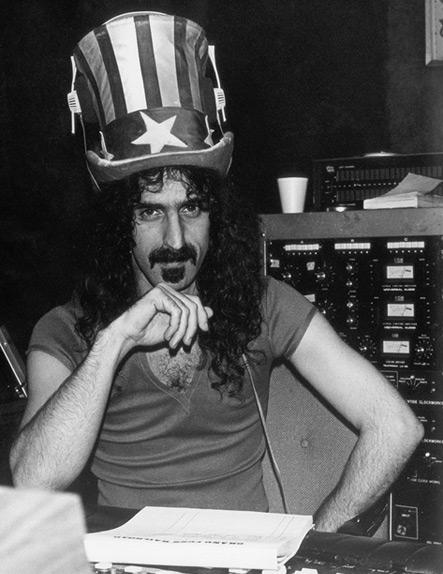
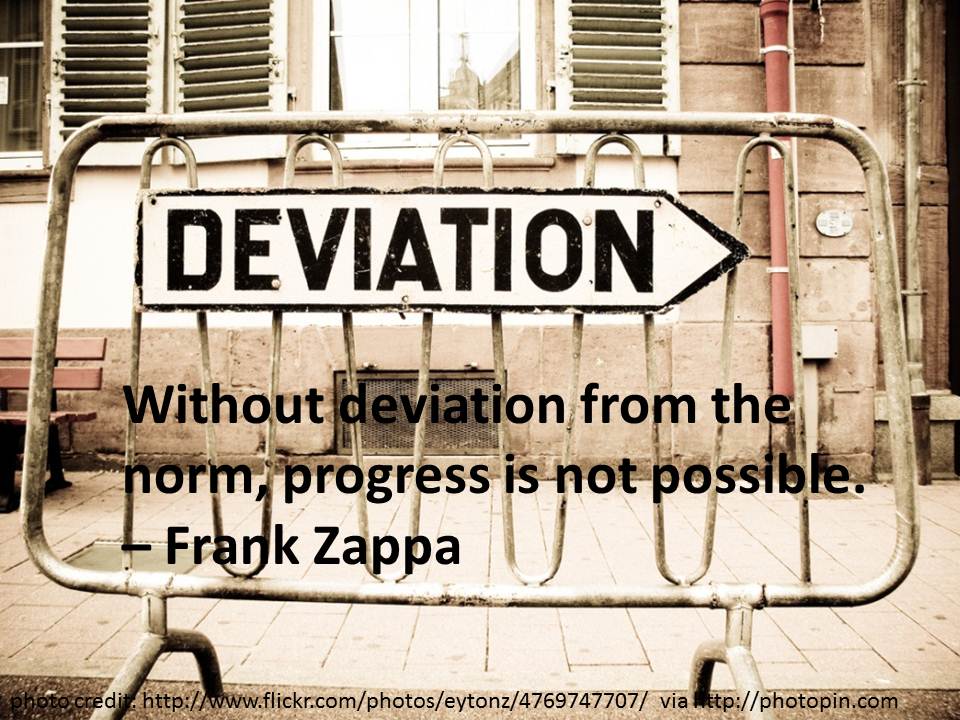
Frank Zappa deviation quotation
I love thinking (and quotations) that come from unexpected sources. Sometimes the power of the idea seems stronger or more profound when we know the source.
Frank Zappa certainly meets this criteria. Zappa was a free thinker, talented musician and much more (I encourage you to read a bit of his Wikipedia entry if you don’t know much about this complex rock star).
Add to the mix that today’s quotation takes a word most people probably have negative thoughts attached to and puts it in a new light. All those elements lead to a very useful and intriguing thought (and I hope, post).
“Without deviation from the norm, progress is not possible.”
Frank Zappa, singer-songwriter
Questions to Ponder
- When was the last time I looked at deviation as a good thing?
- How can I put the word deviation in a better light in my life?
- What progress am I missing by dismissing things “different from the norm”?
Action Steps
1. Look for the abnormal and unusual today.
2. Look at mistakes, not just as something to be fixed, but something to be learned from.
3. Look for ways to promote deviation from the norm, as a strategy for innovation.
quotation from Frank Zappa

My Thoughts
In the workplace, deviation often refers to the statistical idea of a result different from what is intended. Starting with the work of Joseph Juran and W. Edwards Deming, organizations have tried to manage and reduce variation to produce higher quality outputs. All of this is the precursor to the Lean and Six Sigma processes widely used today. In these worlds deviation is to be reduced and eliminated.
Look at the dictionary definitions of this word and you will find many of them skewing to negative ideas (the word “abnormal” is used – rarely considered a good thing). And I’m sure the idea of a social deviant or deviant behavior comes to your mind when you think about this word.
And yet, Zappa is right.
If nothing ever changes, nothing will change – and no progress will even been seen as possible.
Are you stifling the out of the box thoughts? Is your team hiding the deviations (read mistakes) in their work processes? Now that you have read these thoughts, I challenge you to read the quotation again, ask yourself the questions and take the action described above.

Friday, September 7, 2012

Last Year's Ideas

More wisdom from Kevin Eikenberry--one of my favorite on-line leadership mentors. 


Last Year’s Ideas

by Kevin Eikenberry on August 24, 2012
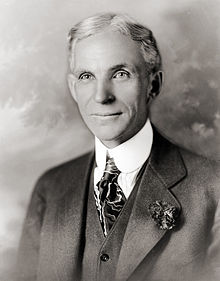
Henry Ford quotationI found this quotation in the front of a book I began reading this week – Wheels for the World by Douglas Brinkley. The book is about the history of the Ford Motor Company, and on the page opening the book there are three quotations, one from Henry Ford himself.
I have shared this quotation with two groups this week, and so it seemed appropriate to share it here as well.
” Businessmen go down with their businesses because they like the old way so well they cannot bring themselves to change. One sees them all about – men who do not know that yesterday is past, and who woke up this morning with their last year’s ideas.”
- Henry Ford, Industrialist

Questions to Ponder

- How do you feel about change?
- How wed are you to your past ideas?
- How often do you generate new ideas for your projects and activities?

Action Steps

1. Look at your business, projects or activities with a blank sheet of paper.
2. Consider what the current and future situations look like.
3. Then determine what the best course of action would be – starting from the blank sheet of paper, not with everything that currently exists.
4. Use those insights to determine what new ideas must be implemented.

My Thoughts

This quotation struck me when I first read it, and it had a similar impact when I read it to groups. It seems to me that, while we can all fall into this trap (women too, though that wasn’t how Ford framed it in his day), the trap might be most dangerous when things are going well.
It is easy to be a believer in your current ideas when you are having success.
It is easy to lose sight of the need to change when profits are high.
It is easy to get complacent.
And when we do, in our minds, new ideas aren’t needed – let alone welcomed.
If things are going well for you now, or even if they aren’t, think about this question – Did I wake with last year’s ideas or am I looking to the future for new ones?

Unleashing Your Remarkable Potential

Monday, August 22, 2011

Set the Example

Once again Kevin Eikenberry has provided some valuable insights for our Esperanza leaders and educators.

To lead someone or something means, literally, to be in front, so that others can see and follow in that direction. Stated another way, if you think you are leading, but no one is following, you are just taking a walk. The following are 7 ways to set an example for others to follow.

Attitude
As a leader, they are looking to you, watching for clues and modeling your attitude. . If you don’t do it, who else will?

Learning
Every leader wants those they lead to be learning, developing and growing. It is hard to convince them to do so if they don’t see you doing it

Expectations
The expectations you have for others will impact their performance, positively or negatively. Which way will it be? Are you going first by raising your expectation of others so they can build confidence, urgency and discipline to reach those expectations? It won’t happen automatically. Set your expectations of others, let people know you believe in them, then watch them grow!

Change
If you want to affect and implement change you must be a champion of it. Are you open to trying new things?

Trust
Offer them trust. Be more trustworthy. Waiting for others to take the lead, could be a long wait. Extend and offer trust first. Occasionally you will get hurt, more often greater trust will build.

Questions
Stop talking and start asking. Ask questions first. Ask questions often. Listening
Certainly, once you ask a question you will be best served by listening to the response. Setting an example means taking the risk, doing what is necessary, doing what no one else is doing. It means going first.